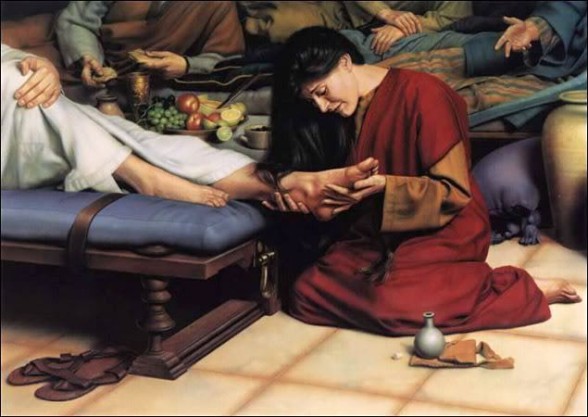
“You know that after two days [in two days] is the Passover, and the Son of Man will be delivered up to be crucified.” Matthew 26:2.
“And when Jesus was in Bethany at the house of Simon the leper, a woman came to Him having an alabaster flask of very costly fragrant oil, and she poured it on His head as He sat at the table.” Matthew 26:6-7.
There are three passages which mention a woman who anoints Jesus with precious oil. In the examination of “Two Women, Part 1” posted on 1-28-25 there is a fourth account, that of a sinful woman.
That account has nothing to do with the three passages herein. The sinful woman incident occurred early in Jesus’ ministry.
In worship and in repentance for her many sins, she washed the Lord’s feet with her tears and dried them with her hair before anointing them with costly oil.
Having separated that account from these three we shall now examine them.
“You know that after two days [in two days] is the Passover, and the Son of Man will be delivered up to be crucified.” Matthew 26:2.
The information above, given by Jesus Himself tells us that the Passover was in two days. This is important because in all three passages the supper He attended was two days before the Passover.
“And when Jesus was in Bethany at the house of Simon the leper…” Matthew 26:6.
The house of Simon the leper is mentioned in two passages but not in John 12, though Bethany is mentioned. It is John chapter 12 that gives us the most difficulty
“After two days [in two days] it was the Passover and the Feast of Unleavened Bread. And the chief priests and the scribes sought how they might take Him by trickery and put Him to death.” Mark 14:1.
“And being in Bethany at the house of Simon the leper, as He sat at the table, a woman came having an alabaster flask of very costly oil of spikenard. And she broke the flask and poured it on His head.” Mark 14:3.
As in Matthew 26 we find that we are at the same house of Simon the leper in Bethany two days before the Passover. In this case, compare the last two lines in Mark 14:3 with those from Matthew 26:7 below.
“…a woman came having an alabaster flask of very costly oil of spikenard. And she broke the flask and poured it on His head.” Mark 14:3b.
“…a woman came to Him having an alabaster flask of very costly fragrant oil, and she poured it on His head as He sat at the table.” Matthew 26:7.
With such similar descriptions of this woman and her actions, it is difficult to conceive that they are two different women in these passages.
Now let’s tackle the most difficult of these three passages in John 12 next.
“Then, six days before the Passover, Jesus came to Bethany, where Lazarus was who had been dead, whom He had raised from the dead. There they made Him a supper; and Martha served, but Lazarus was one of those who sat at the table with Him. Then Mary took a pound of very costly oil of spikenard, anointed the feet of Jesus, and wiped His feet with her hair. And the house was filled with the fragrance of the oil. Then one of His disciples, Judas Iscariot, Simon’s son, who would betray Him, said, why was this fragrant oil not sold for three hundred denarii and given to the poor? This he said, not that he cared for the poor, but because he was a thief, and had the money box; and he used to take what was put in it. Then Jesus said, Let her alone; she has kept this for the day of My burial. For the poor you have with you always, but Me you do not have always.” John 12:1-9.
The confusing part here is that it is not noted that it is two days before the Passover, but six days, “Then, six days before the Passover, Jesus came to Bethany…” Is this a reference to a second supper?
The answer is no, it just means that Jesus came to Bethany 6 days before the Passover. This phrase has nothing to do with the supper 2 days before the Passover. Why then is such a meaningless statement as 6 days before the Passover included in this narrative?
This is a surprisingly important statement regarding the Passover itself. Devout men would come to participate in the Passover six days early to prepare for the solemnity of the occasion.
While I cannot find anything in Scripture commanding this, such a tradition makes sense for men to prepare for such a solemn occasion.
It may have come from something men were commanded to do during the Day of Atonement, about four months later, “you shall afflict your souls”, quoted from Numbers 29:7. Men must come before God with hands cleansed of known sin.
This is merely my own speculation, but why men came six days early was because they wanted to prepare their hearts for such a solemn occasion. And Jesus showed His approval of this tradition by arriving six days early too.
A second thing to note about John 12:1 is that it is a single sentence.
In this one verse we have a time, “Then, six days before the Passover”, and we have a location, “Jesus came to Bethany, where Lazarus was who had been dead, whom He had raised from the dead.” This verse then ends with a period, separating it from the rest of the passage. The point here is that the six days before the Passover does not have any connection to the day of the supper.
“There [where Lazarus was in Bethany] they made Him a supper; and Martha served, but Lazarus was one of those who sat at the table with Him. Then Mary took a pound of very costly oil of spikenard, anointed the feet of Jesus, and wiped His feet with her hair. And the house was filled with the fragrance of the oil.” John 12:2-3.
Before going further let us examine a beautiful picture. The names given are those of three siblings, Martha, Lazarus and Mary, Lazarus likely being the youngest (learn more about this family in Luke 10:38-42 and John 11:1-44).
John 12:2-3 above notes that Martha served, and Lazarus sat at the table with Jesus, and Mary anointed Jesus’ feet with oil of spikenard.
These are three aspects of Christian life, Martha represents service, Lazarus is an example of fellowship, and Mary worships. The healthy Christian will do all these things at one time or another.
Now let us examine some other aspects of this passage to confirm whether this is the same woman and the same incident.
“Then Mary took a pound of very costly oil of spikenard, anointed the feet of Jesus, and wiped His feet with her hair. And the house was filled with the fragrance of the oil.” John 12:3.
This young lady is Mary, the sister of Lazarus and Martha. Here we see Mary doing the same thing as in the other accounts, “Mary took a pound of very costly oil of spikenard, anointed the feet of Jesus…” the main difference here is that she anointed His feet, not His head as in the last accounts.
By anointing Jesus’ head, the woman testifies that He is the King of kings, Israel’s Messiah, and the fact that she anointed His head shows that she has accepted Him as Lord.
However, this last passage signifies nothing less than worship:
“…anointed the feet of Jesus, and wiped His feet with her hair. And the house was filled with the fragrance of the oil.” John 12:3b.
True worship can fill a room with a sense of peace that is beyond anything the world can give.
However, Satan will do anything to disrupt worship or even meditation on the Lord Jesus.
“And the house was filled with the fragrance of the oil. Then one of His disciples, Judas Iscariot, Simon’s son, who would betray Him, said, why was this fragrant oil not sold for three hundred denarii and given to the poor? This he said, not that he cared for the poor, but because he was a thief, and had the money box; and he used to take what was put in it.” John 12:3b-6.
I left this brouhaha out of the other two passages quoted earlier for brevity. So, here is a portion of each of the two others:
“But when His disciples saw it, they were indignant, saying, ‘To what purpose is this waste? For this fragrant oil might have been sold for much and given to the poor.’” Matthew 26:8-9.
“But there were some who were indignant among themselves, and said, ‘Why was this fragrant oil wasted? For it might have been sold for more than three hundred denarii and given to the poor.’ And they criticized her sharply.’” Mark 14:4-5.
If you carefully compare these three quotes from, Matthew 26:8-9, Mark 14:4-5, and John 12:3b-6. It will be hard to deny that these three passages describe Mary anointing Jesus at supper two days before the Passover.
The final words of Jesus to those who scolded Mary for her sacrifice, are quoted below, though the three quotes are each slightly different.
“Then Jesus said, Let her alone; she has kept this for the day of My burial. For the poor you have with you always, but Me you do not have always.” John 12:1-9.
Two Women, Part 2 taken from godisrevealed.com posted on 2-2-25 ck.
Scripture taken from the New King James Version, copyright 1982 by Thomas Nelson, Inc. Used by permission, all rights reserved.